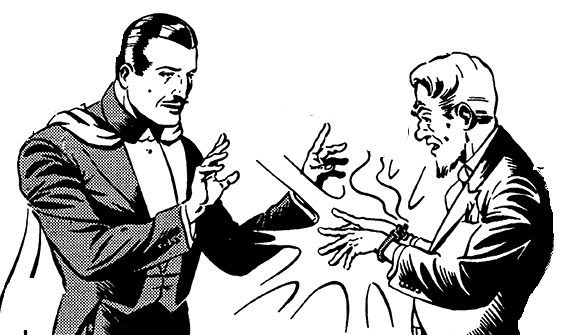
Business models, business schmodels sa Mandrake and did a magical gesture.
“A business model or company model, English business model, is in corporate economics a theoretical description of how a company, or a business activity, is intended to function. It’s a conceptual tool that contains a set of components and describes their mutual relations in such a way that the business logic for a particular activity can be described concretely.” https://sv.wikipedia.org/wiki/Aff%C3%A4rsmodell
The above is hardly worth noting. Clearly all companies have the right to decide how they earn their money. This little rant, however, is about the frustration of feeling tricked or at least misled by a business model. Probably because it was never presented as such but as the only obvious way to do something.
One example of these models is the chatbot that we chat with in a dialog window. At least most of us do. Yeah, now I have to sit quietly and copy and paste what the AI tells me to write, do or say. But as many have already pointed out, this is not the best way to use language models. Letting them write directly into the documents you want to change yourself is obviously much more logical and effective. Or at least it felt that way when Claude co-work filled in a row of blank templates for me before the declaration. But why did this feature take so long? Of course, because it’s important that we continue to pay for the service that contains the chat window, and then have an integrated experience on the AI provider’s site. The risk is that if you leave the site where you’re talking and wander into the illusion that the AI knows me. The risk is that you discover that all that’s left is a few user cases where a dialog box with a chatty chatbot is the best way to solve this.
So-called memory is another feature that is also part of the hidden business model. What we call memory in a chat gpt simulates human behavior for the purpose of making us feel warmer towards the service and, in the worst case, anthropomorphize it. It’s manipulative brand magic. Yeah, but sure there are functional benefits to having memory. But it doesn’t work at all like we think. Fact is, every time you send a chat message, you’re talking to a language model with completely blank memory. It has no idea who you are. It’s not even certain that you’re talking to the same model between two exchanges of meaning. Therefore, the chatbot must send everything you’ve said before, all information about you and all relevant memories every time you kindly press send.
The last example is the various strategies of social media platforms to succeed. You should post x number of times per day, you should post at certain times, you should be easy-going and predictable. Why? Well, it’s not for users to have a better experience. You might understand where I’m going with this by now. It’s because frequent posting benefits the social media platforms themselves. They want us to believe that this behavior is necessary to succeed but in reality, it’s part of a smart business model that generates content for the platform and entices us with promises of virality. Like the American dream but for content creation.
In conclusion: Business models should be transparent. If they’re hidden under layers of manipulative user design and packaged as something you have to adapt to, there’s a risk that you’ve been tricked.